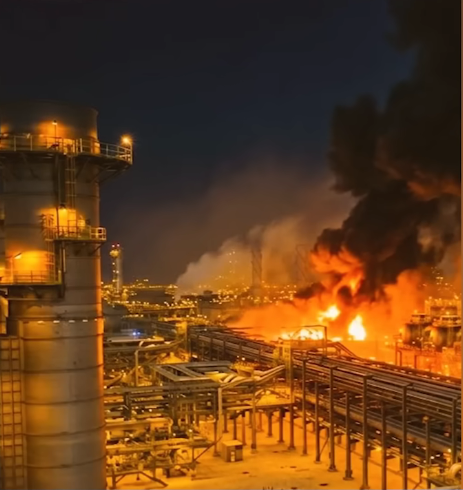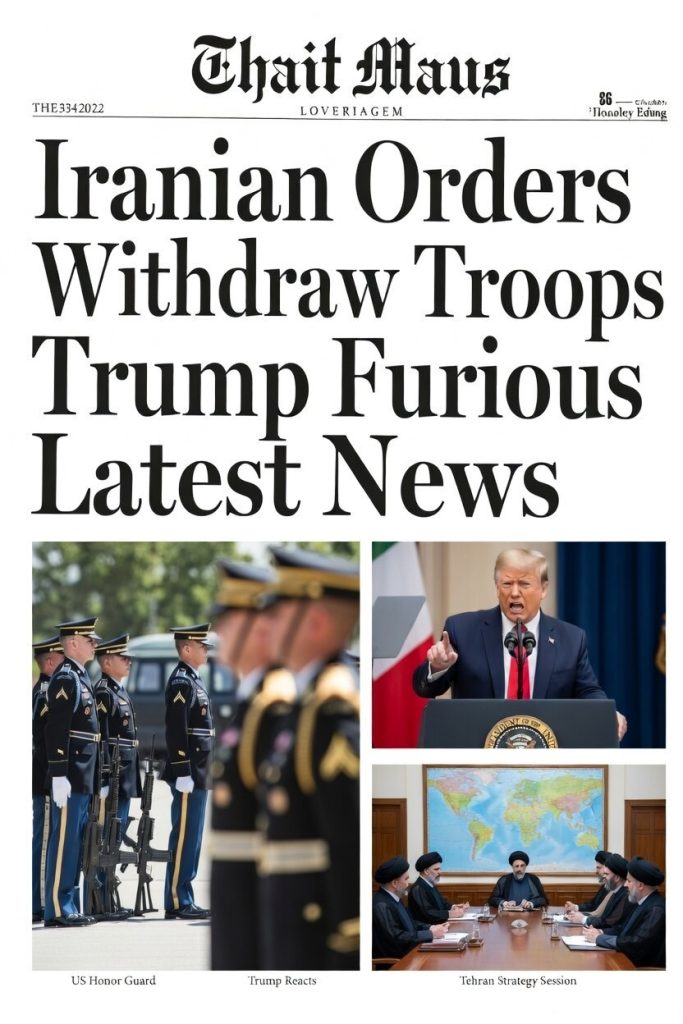
Strikes on Infrastructure, Educational Institutions, and the Expanding Theatre of War
we saw that America, Israel, and Iran were involved, or attacks were being carried out by Hezbollah in Lebanon, but now attacks have started from another country as well.
While previous hostilities primarily involved the United States, Israel, and Iran alongside Hezbollah’s operations in Lebanon, new developments show that attacks have now commenced from additional countries. This expansion of the war zone is accompanied by significant strikes on civilian and industrial infrastructure, as well as high-stakes diplomatic and economic maneuvers.
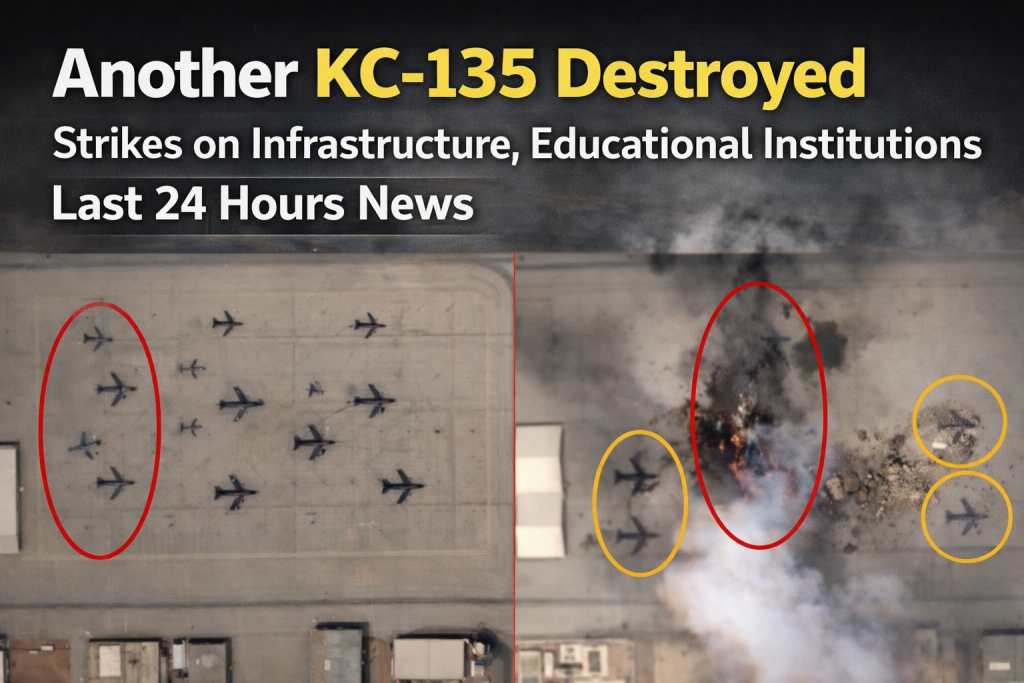
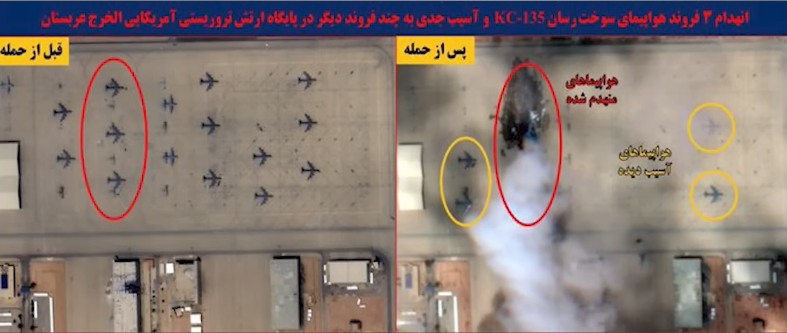
Another Destruction Of Three K-C 135 Aerial Refueling Tankers Prince Sultan Airbase
Aerial and naval assets of the United States have also been targeted. In Saudi Arabia, the Prince Sultan Airbase was bombed by Iran, resulting in the destruction of three K-C 135 aerial refueling tankers and injuries to ten U.S. soldiers, two of whom are in critical condition.
Saudi Arabia has since banned the filming or sharing of strike locations, warning of legal action against those who spread such footage. Additionally, a U.S. facility in Bahrain was targeted, with footage showing large fires at the site. At sea, Donald Trump acknowledged that the aircraft carrier USS Abraham Lincoln was attacked by a “swarm” of drones from 17 different directions. Reports now suggest that the USS George H.W. Bush carrier strike group may be deployed to the region to reinforce or replace existing assets.
Iranian officials have reportedly rejected the proposal
As the conflict enters its second month, U.S. Secretary of State Marco Rubio has stated thIat the operation may be completed in “weeks rather than months,” though he noted that Washington is still awaiting a formal response to a 15-point proposal sent by Iran. While some Iranian officials have reportedly rejected the proposal as favoring only U.S. and Israeli interests, diplomatic channels remain open as the region waits to see if a ceasefire can be reached or if the war will continue to expand.
Targeting Educational and Industrial Infrastructure
In a development that signals a departure from traditional military targeting, educational institutions in both Iran and Israel have come under fire. Israel targeted the University of Science and Technology in Tehran, a historic institution founded in 1929. The attack occurred at 2:30 AM local time, and under international humanitarian law, such facilities including schools and hospitals are typically protected during wartime.
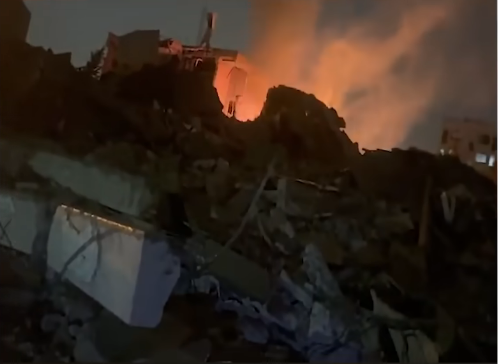
The strategic intent behind targeting a science and technology university appears to be the disruption of Iran’s ability to produce future scientists and engineers. Furthermore, Tehran’s Amir Kabir University suffered severe damage during recent bombings.
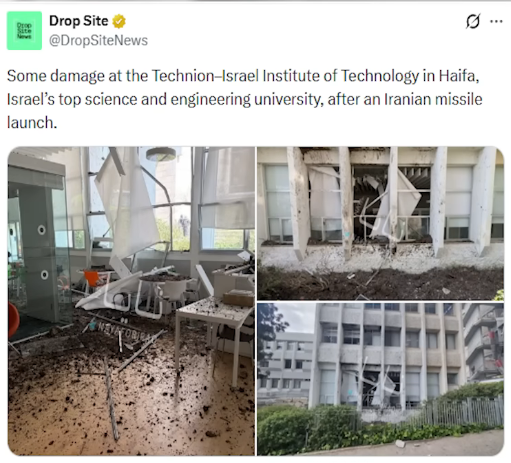
Iran launched an attack on the Technion – Israel Institute of Technology in Haifa
In a direct retaliatory response, Iran launched an attack on the Technion – Israel Institute of Technology in Haifa. As Israel’s premier science, technology, and engineering university, the Technion serves as a symmetrical target to the Iranian institutions hit earlier. This pattern suggests a tactical “mirroring” where Iran aims to strike the same category of facilities that are targeted within its own borders.
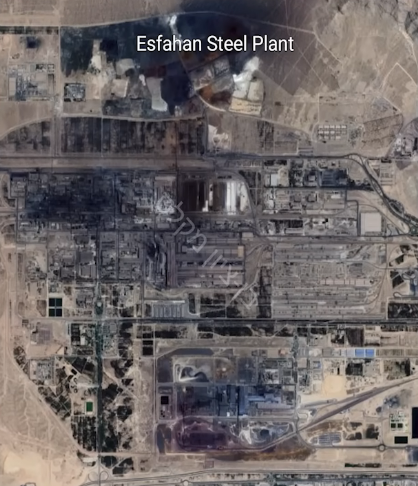
The industrial backbone of Iran has also been heavily impacted. Reports indicate that coordinated strikes have hit three of Iran’s largest steel plants simultaneously: Mobarakeh, Isfahan, and Khuzestan. These three plants together account for approximately 70% of Iran’s total steel production.
The steel industry is Iran’s second-largest export sector, valued at roughly 648 billion dollars.
The steel industry is Iran’s second-largest export sector, valued at roughly 648 billion dollars. Specifically, the Mobarakeh mill produces steel for the automotive and pipeline sectors; the Isfahan plant produces structural beams and railway tracks; and the Khuzestan facility produces raw slabs for various industrial structures.
Following these strikes, Sayyed Majid Mousavi, commander of the IRGC Aerospace Force, warned that the “equation will no longer be an eye for an eye” and advised employees of industrial companies linked to the U.S. and the “Zionist regime” to evacuate their workplaces to avoid danger.
Military Escalation and Regional Impacts
The scale of military operations has increased across several fronts. In Isfahan Iran, air strikes by U.S. and Israeli forces reportedly hit a residential complex, resulting in 26 fatalities, including seven women and seven children. Meanwhile, in Tehran, rescue workers spent hours extracting a survivor from the rubble of a building destroyed by falling debris. Other Iranian regions, including Ahvaz and Kantara, were subjected to intense bombing directed at military sites.
Israel has also claimed a significant strike on the Arak Heavy Water Plant
Israel has also claimed a significant strike on the Arak Heavy Water Plant in central Iran. The Israel Defense Forces (IDF) identified this as a key plutonium production site for nuclear weapons and stated they would not allow the Iranian regime to advance a program that poses an “existential threat”.
Regarding nuclear safety, the International Atomic Energy Agency (IAEA) reported that Iran informed them of a new attack near the Bushehr Nuclear Power Plant, the third such incident in ten days. While the reactor was not damaged and no radiation leak occurred, the IAEA Director General expressed deep concern that damage to such a facility could lead to a major radiological accident.
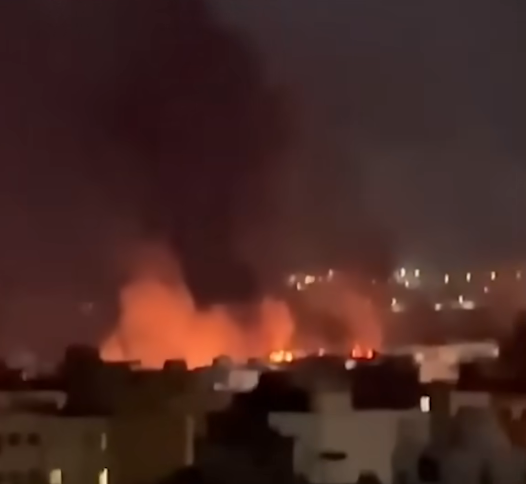
In a significant expansion of the war, a missile was fired from Yemen toward Israeli territory, marking the first such occurrence since the start of the conflict. The Iranian-backed Houthis claimed responsibility, stating they used ballistic missiles against “sensitive Israeli military targets”. They warned that they would join the Middle East war fully if attacks on Iran persist and declared that their operations would continue until their goals are achieved or if other nations join the U.S. and Israel against Iran.
Political Tensions and Intelligence Failures
The ongoing war has exposed internal rifts among allies. Reports suggest a serious conflict between Israeli Prime Minister Netanyahu and the head of Mossad. Netanyahu allegedly accused the Mossad chief of providing faulty intelligence regarding Iran’s military strength and internal stability, while the Mossad head reportedly skipped high-level meetings for a week in protest.
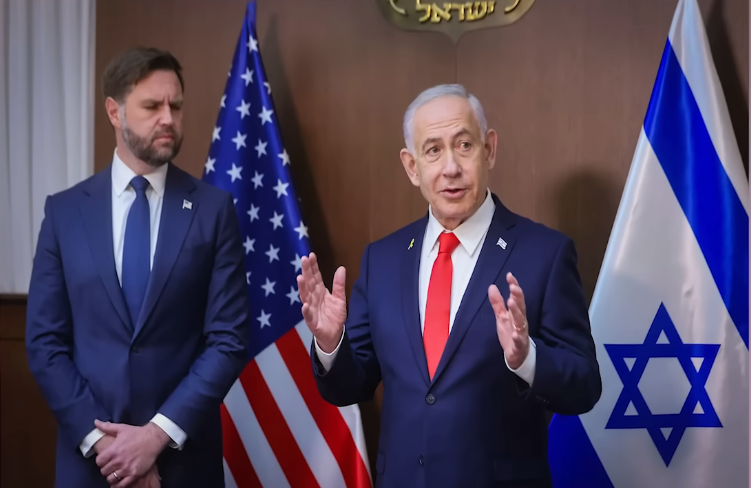
Tense Phone Call Took Place Between U.S. Vice President JD Vance and Netanyahu.
Furthermore, a tense phone call took place between U.S. Vice President JD Vance and Netanyahu. Vance reportedly “scolded” Netanyahu for providing false hope that regime change in Iran would be easy and for failing to deliver on the “dreams” he had sold to Donald Trump regarding a quick victory.
In the realm of cyber warfare, the U.S. has announced rewards for information on Iranian hackers, noting that even the personal account of an FBI-linked official, Akash Patel, was successfully compromised. This highlights the difficulty Western agencies are facing in containing Iranian cyber operations.
Diplomatic Mediation and Pakistan’s Unique Position
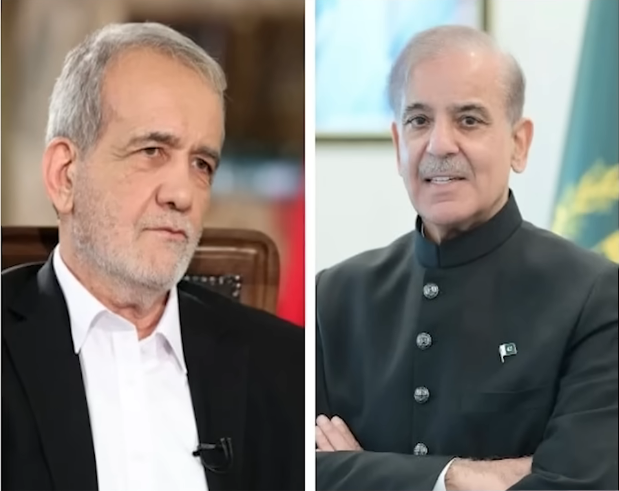
Amidst the fighting, diplomatic efforts are intensifying. Pakistan is playing a central role as a mediator between Tehran and Washington. Prime Minister Shehbaz Sharif and Iranian President Masoud Pezeshkian held a one-hour telephonic discussion to coordinate de-escalation efforts.
On March 30th, Islamabad will host a quadrilateral meeting featuring the Foreign Ministers of Turkey, Saudi Arabia, Egypt, and Pakistan. Turkish Foreign Minister Hakan Fidan noted that the meeting was moved to Pakistan to accommodate the Pakistani leadership’s need to remain in the country.
Geopolitical analysts, such as Pravin Sawhney, have noted that Pakistan is currently in a unique position where the U.S., China, and Russia all seek to maintain good relations with it. Additionally, Ukraine has entered the regional dynamic, with President Zelensky signing a defense agreement with Saudi Arabia and pledging to assist Israel with anti-drone technology. Ukraine has reportedly deployed anti-drone military units in five Middle Eastern countries: Saudi Arabia, UAE, Qatar, Kuwait, and Jordan.
Economic Consequences: Oil and Trade
The escalation has had immediate economic repercussions. International oil prices have surged, breaking previous trading bands to reach approximately $106.84 per barrel. Iranian officials have accused the U.S. of spreading “fake news” to keep energy prices artificially low, asserting that the market no longer believes these claims following the strikes on industrial infrastructure.

For Pakistan, the disruption of shipping routes in the Persian Gulf has led to a massive increase in activity at its ports. In just 24 days, the Karachi Port handled 8,313 containers a volume equivalent to what it typically handles in an entire year.
This surge in transshipment at Karachi, Port Qasim, and Gwadar
This surge in transshipment at Karachi, Port Qasim, and Gwadar is providing the country with significant foreign exchange through parking fees and service charges. Furthermore, Pakistan has reached a staff-level agreement with the IMF for a funding facility of approximately 1.2 billion dollars, marking a critical breakthrough after weeks of negotiations.
1. KC-135 Stratotanker Destroyed / Damaged (Recent Iranian strikes on Prince Sultan Air Base, Saudi Arabia)
- https://www.militarytimes.com/news/your-military/2026/03/16/iran-missile-strike-damages-five-kc-135-tankers-in-saudi-arabia-officials-say/
- https://theaviationist.com/2026/03/27/iranian-attack-on-prince-sultan-air-base/ (Satellite images + latest attack)
- https://en.wikipedia.org/wiki/List_of_aviation_shootdowns_and_accidents_during_the_2026_Iran_war (Multiple KC-135 incidents listed)
- https://militarnyi.com/en/news/iran-destroyed-another-us-kc-135-tanker/ (Recent destruction claim with satellite imagery)
- https://www.ndtv.com/video/saudi-arabia-news-satellite-images-show-damage-at-saudi-air-base-after-suspected-iran-strike-1077225
2. Strikes on Infrastructure in Iran
- https://www.bbc.com/news/articles/cpw004xqxnjo (Damage to hospitals, landmarks & civilian infrastructure)
- https://www.aljazeera.com/news/2026/3/2/iran-demands-international-action-after-attacks-impact-hospitals-schools (Hospitals & civilian sites hit)
- https://www.energypolicy.columbia.edu/infrastructure-strikes-in-iran-war-escalate-global-energy-crisis/ (Energy & infrastructure strikes impact)
3. Strikes on Educational Institutions (Schools & Universities)
- https://en.yenisafak.com/world/us-israeli-strike-hits-irans-isfahan-university-of-technology-no-casualties-3716324 (Isfahan University of Technology hit)
- https://www.ndtv.com/video/iran-media-claims-strike-on-tehran-university-no-official-confirmation-1077259 (Tehran University claim)
- https://macaubusiness.com/iranian-fm-says-over-600-schools-damaged-amid-u-s-israeli-strikes/ (Iran FM claim of 600+ schools damaged)
If you want to read more news: Read Here